16th November 2026
From the UFC to everyday self-defense, discover why Muay Thai has become one of the most respected and effective striking arts in the world.
Martial arts have never been more popular. From the explosive growth of the UFC to the increasing number of people looking for practical self-defense training, more people are discovering the benefits of learning how to fight.
And one martial art continues to stand out: Muay Thai.
Known as the Art of Eight Limbs, Muay Thai has evolved from Thailand’s national sport into one of the most influential striking disciplines in modern mixed martial arts.
But its growing popularity isn’t just about professional fighters throwing devastating kicks, knees, and elbows. It’s about something much more important.
Muay Thai works because it teaches you to understand fighting rather than memorize what to do in a specific situation.
And whether your goal is self-defense, fitness, confidence, or competition, that distinction makes all the difference.
Watch almost any UFC event and you’ll see the influence of Muay Thai.
Leg kicks, body kicks, knees from the clinch, elbows in close quarters, and the ability to transition between different striking ranges are all techniques closely associated with Muay Thai.
While successful MMA fighters combine techniques from several disciplines, Muay Thai has become one of the foundational striking systems used in modern mixed martial arts.
Why?
Because Muay Thai provides fighters with an incredibly versatile set of tools.
Traditional boxing primarily focuses on punches. Taekwondo emphasizes kicking techniques. Other striking arts have their own strengths and specialties.
Muay Thai integrates punches, kicks, knees, elbows, and clinch fighting into one comprehensive striking system.
This versatility makes it particularly valuable in MMA, where fighters must adapt to opponents with different styles, abilities, and strategies.
Of course, MMA requires additional skills, including wrestling, takedown defense, and ground fighting. But when it comes to striking, Muay Thai has earned its place among the most influential disciplines in the sport.
And that same versatility is one of the reasons it can be so useful outside the cage.
One of the biggest misconceptions about self-defense is that you need to memorize dozens of techniques for dozens of different situations.
What do you do if someone grabs your wrist?
What if they grab your shirt?
What if they throw a particular punch?
What if they approach you from a certain angle?
Some self-defense systems focus heavily on teaching specific responses to specific attacks.
The problem is that real confrontations are unpredictable.
People don’t always attack the way your training partner does. They don’t follow a script, and they certainly don’t cooperate while you execute a complicated sequence of movements.
Muay Thai approaches fighting differently.
Rather than relying primarily on memorized scenarios, Muay Thai teaches you to recognize distance, maintain balance, control your positioning, and understand which techniques are available at any given moment.
This is one of its greatest strengths.
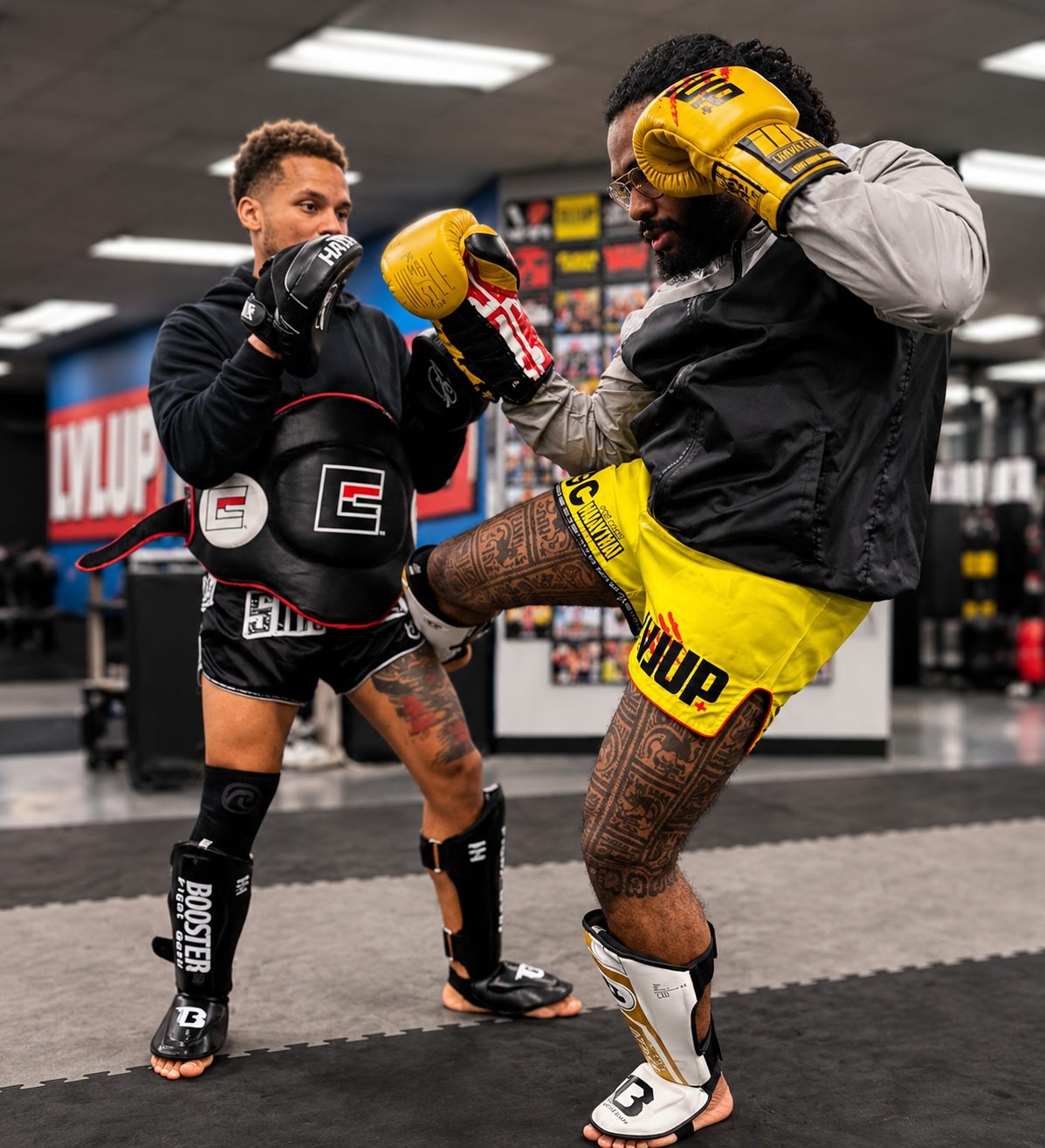
Long range: When an opponent is farther away, kicks and footwork can help you manage distance.
Mid-range: As the distance closes, punches and combinations become more relevant.
Close range: At closer distances, elbows, knees, and clinch techniques become available.
By understanding these ranges, a trained person learns to recognize opportunities and threats without having to mentally search through a list of predetermined techniques.
Instead of thinking, “Which move am I supposed to use in this exact situation?”
They begin thinking instinctively about distance, positioning, balance, and the tools available to them.
That ability to recognize what’s happening and respond appropriately is developed through repetition, partner drills, and controlled sparring.
And it can make a significant difference when someone is under pressure.
There’s an important distinction between a martial art that teaches techniques and one that regularly tests those techniques against resistance.
Muay Thai is, at its core, a combat sport.
Its techniques have been developed, refined, and tested through generations of actual competition.
That doesn’t mean everyone who trains Muay Thai needs to become a fighter.
Far from it.
But it does mean that the training methods are rooted in techniques that have to work against someone who is actively trying to stop them.
Students learn how to strike with proper mechanics, defend themselves, move under pressure, and maintain their composure when things become uncomfortable.
As they progress, controlled partner training helps them develop something that can’t be learned simply by watching demonstrations:
The ability to make decisions while another person is resisting them.
That is one of the most valuable aspects of combat-sport training.
In a real self-defense situation, the safest outcome is always to avoid the confrontation, create distance, and escape whenever possible.
No martial art guarantees your safety, especially when weapons, multiple attackers, or unexpected circumstances are involved.
But developing practical striking skills, awareness, balance, and experience under controlled pressure can give you a much stronger foundation than relying on techniques you’ve never tested against resistance.
Confidence is one of the biggest benefits of martial arts training.
But there’s a difference between believing you can defend yourself and developing confidence based on actual experience.
In Muay Thai, progress is earned.
You learn how to throw a proper punch. You learn how to kick without losing your balance. You learn to defend yourself against incoming strikes.
Eventually, you begin putting those skills together.
With consistent training, movements that once felt awkward become natural.
You start recognizing distance more quickly. You become more comfortable under pressure. You learn to stay composed instead of panicking.
And perhaps most importantly, you develop a realistic understanding of your own abilities and limitations.
Real confidence doesn’t come from believing you’re invincible. It comes from knowing you’ve put in the work.
For many students, that confidence carries into everyday life, even if they never have any intention of competing.
While Muay Thai has become a global phenomenon, its roots remain deeply connected to Thailand.
The sport carries centuries of history, cultural identity, and tradition.
From the ceremonial Wai Kru Ram Muay, performed by fighters to show respect to their teachers and heritage, to the traditional mongkhon headpiece and the music accompanying bouts in Thailand, Muay Thai represents much more than physical combat.
It is an art built around respect, discipline, humility, and perseverance.
And those traditions remain an important part of what makes Muay Thai special.
At its best, Muay Thai training teaches students to balance physical toughness with self-control and respect for others.
You can appreciate the effectiveness of its techniques while also appreciating the culture that created them.
That’s part of the beauty of the Art of Eight Limbs.
Muay Thai is both a highly effective combat sport and a living cultural tradition.
Here’s something that surprises many beginners:
You don’t have to want to fight to enjoy Muay Thai.
In fact, many people begin training simply because they’re looking for a workout that’s more engaging than running on a treadmill or lifting weights.
And Muay Thai delivers.
A typical class can incorporate footwork, punching combinations, kicks, knees, defensive movements, pad work, and conditioning.
You’re constantly using your entire body.
Your legs generate power. Your core stabilizes and rotates your body. Your shoulders and arms work through combinations. Your cardiovascular system is challenged as you move from one exercise to another.
Muay Thai training can help improve:
And because you’re learning new skills, there’s always something to work toward.
You’re not just counting repetitions or waiting for the workout to end.
You’re developing abilities that become more refined every time you train.
This is where we believe Level Up Boxing & Fitness offers something especially valuable.
There are plenty of fitness classes that incorporate punches and kicks into a workout.
Often called cardio kickboxing, these classes can be a fun and effective way to burn calories, improve endurance, and get moving.
But there’s an important distinction.
Cardio kickboxing is generally designed around exercise. Muay Thai and traditional kickboxing classes are designed around learning actual striking skills.
At Level Up Boxing & Fitness, our Muay Thai & Kickboxing classes give you the best of both worlds.
You still get the structured, full-body workout you’re looking for.
You’ll work up a sweat, challenge your conditioning, and train in an energetic group environment.
But you’re also learning real technique.
We teach students how to properly throw punches and kicks, generate power, defend themselves, manage distance, and put combinations together.
You’re not simply imitating fighting movements for exercise.
You’re learning the mechanics and principles behind them.
Because technique gives your training purpose.
A beginner might arrive wanting to get in shape, but after a few weeks, they may discover that they can throw a kick with better balance, move more confidently, and understand how to defend against a punch.
The workout becomes more rewarding because they’re developing a skill.
And those skills continue to grow long after the initial fitness goals have been reached.
You can get a great workout almost anywhere. At Level Up, you can get a great workout while learning something real.
One of the biggest reasons people hesitate to try Muay Thai is the assumption that they need to be in shape before they begin.
They see professional fighters training, hitting pads, or sparring and think, “I’m not ready for that.”
But everyone starts somewhere.
You don’t need previous martial arts experience.
You don’t need to know how to throw a punch.
And you certainly don’t need to have any interest in stepping into a ring.
Good beginner training introduces techniques progressively, allowing students to build their fitness and confidence as they learn.
At Level Up Boxing & Fitness in Lanham, Maryland, our Muay Thai & Kickboxing classes welcome beginners who want to learn proper technique in a structured, supportive environment.
Whether your goal is to lose weight, improve your conditioning, learn practical striking skills, or eventually compete, the foundation starts with the same thing:
Learning the fundamentals and showing up consistently.
Muay Thai’s growing influence isn’t an accident.
It combines practical striking techniques, adaptability, realistic training methods, exceptional physical conditioning, and a rich cultural tradition.
Its prominence in MMA has introduced millions of people to the Art of Eight Limbs, but its appeal extends far beyond professional fighting.
For everyday students, it offers something rare: a challenging workout that also develops real, transferable skills.
And that’s why Muay Thai continues to attract people from all walks of life.
At Level Up Boxing & Fitness, we believe martial arts training should be both rewarding and purposeful.
You should leave class knowing you got a great workout.
But you should also leave knowing you learned something.
If you’re looking for Muay Thai or kickboxing classes in Lanham, Bowie, Largo, or the surrounding Maryland area, Level Up Boxing & Fitness is ready to help you get started.
Our classes combine authentic striking instruction, structured training, and full-body conditioning for students of different experience levels.
No experience necessary. No pressure to compete. Just real training, real technique, and real progress.
Visit Level Up Boxing & Fitness to learn more about our programs and get started with a free class or our 4-week introductory program.
Recent Comments